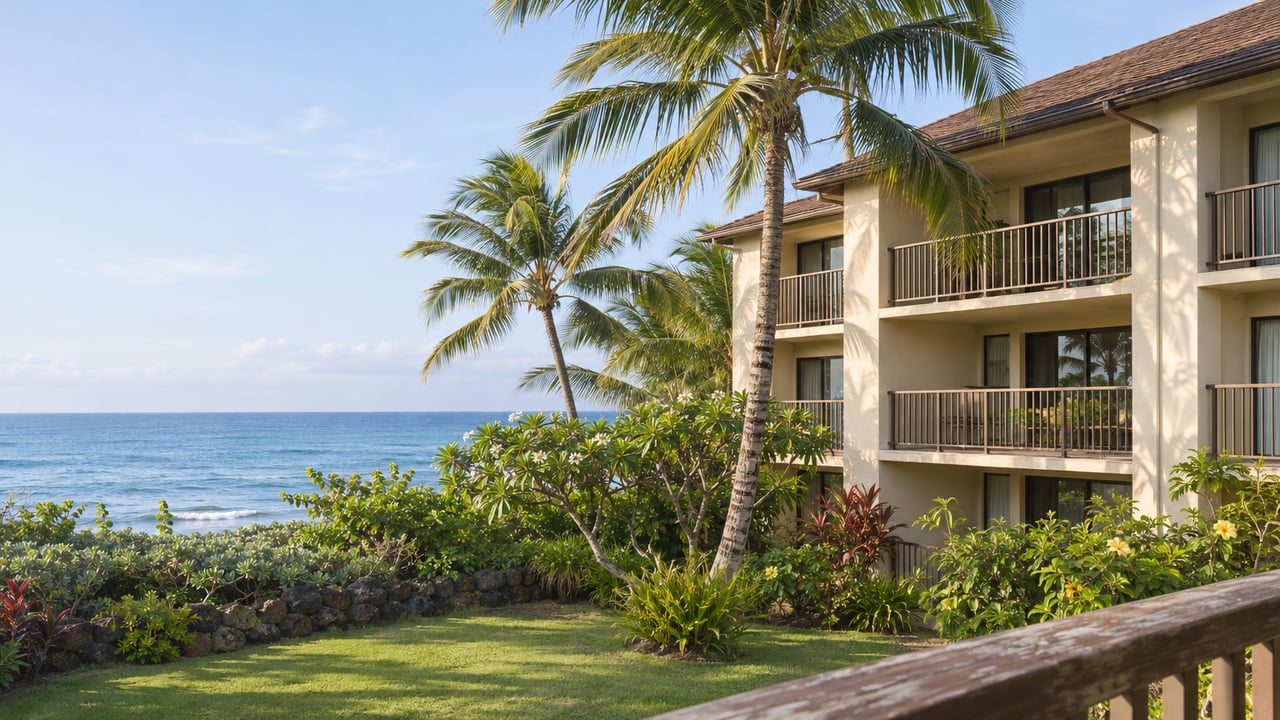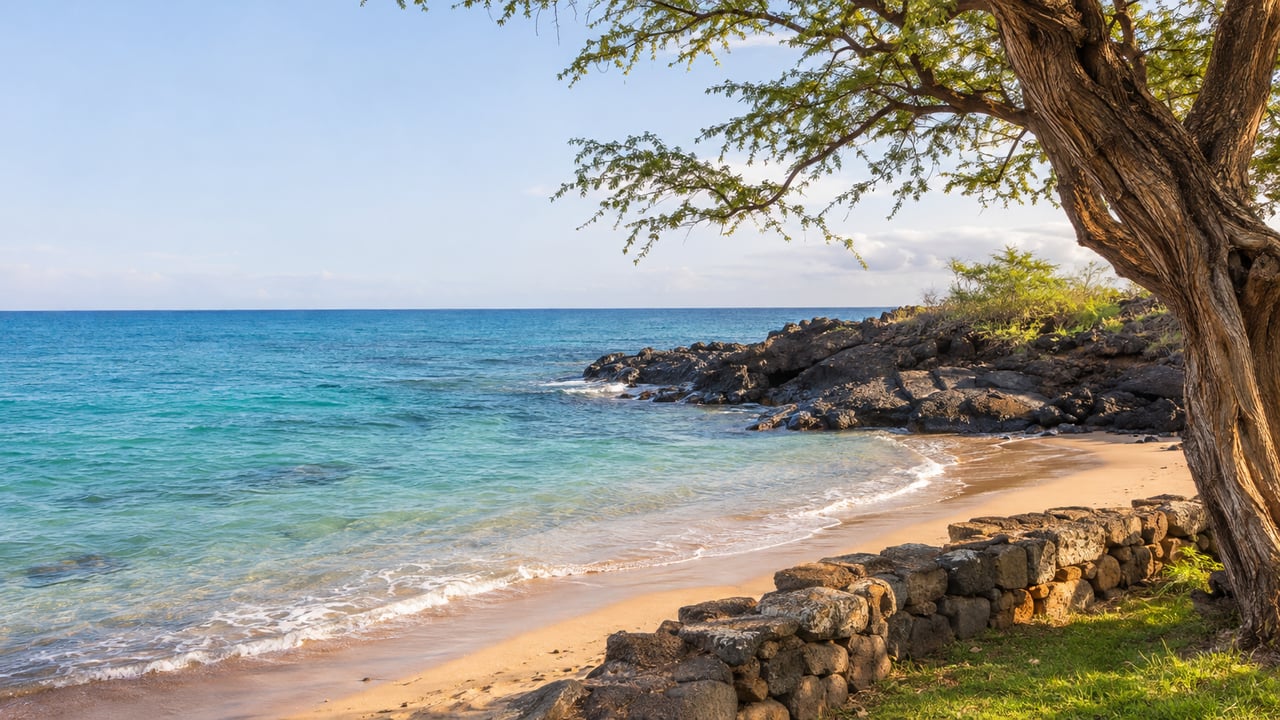
The overflow directions for Christmas Eve at Keawalaʻi Congregational Church start at the south Maluaka Beach parking lot. Take Makena Alanui past Honoiki Street, turn right onto Makena Keonoio Road, then leave yourself time to walk the pathway through to the church. On December 24 that walk leads to 500 seats set up outdoors at 5300 Mākena Road, facing the water at sunset.
The water there is ʻĀpuakehau Bay. Long before anyone built a pier at Mākena Landing, this bay was where Mākena came and went by sea. That history is the best reason to spend part of December on these grounds. The church's holiday calendar is held at the oldest gathering place on this coast, in a building Mākena families have rebuilt with their own hands in nearly every generation since 1832.
The Bay Under the Church Was Mākena's First Landing
Project Kaʻeo is a 2007 cultural study of this stretch of Honuaʻula. Its earliest maps of the area, from around the 1840s, show an ʻAupuni, or government, road running down from the upland trail between Makawao and Ulupalakua. The road ended at ʻĀpuakehau Bay, where the church stands today. The study describes the bay as an important canoe landing and a traditional center for many centuries. It is also known as Keawakapu, and ʻĀpuakehau Point holds the remains of a fishpond that residents valued.
The study says convict labor most likely built the road during the rule of Maui Governor Hoapili, 1824 to 1840. By 1847 a government official called it "in miserable condition," with no one willing to repair it. In the late 1840s, Linton Torbert, the founder of what became Ulupalakua Ranch, proposed a better road, finished in the early 1850s, connecting his sugar plantation to a newly established steamship landing on Mākena Bay. That is today's Mākena Landing. The study explains why Torbert needed a landing of his own: in the Mahele, the land around the government landing at ʻĀpuakehau had gone to a prominent Hawaiian named Mahoe.
Mākena Landing grew quickly. By the 1860s it was the main port for the whole region and the second-busiest port on Maui after Lahaina. In 1877 the Kingdom's Legislature put $1,000 toward a breakwater there and pledged another $1,500 on the condition that "Makena Landing will become a public landing." Mākena Landing became the commercial port, and ʻĀpuakehau kept its church.
Built by the Beach Side and the Forest Side
Keawalaʻi was founded in 1832 as the Church of Honuaʻula, and its first building was pili grass. When the congregation rebuilt in stone and wood, members who lived near the beach gathered coral rock to make the puna, or cement, and members from the "forest side" carried the lumber down. K. Ke Kamana was the carpenter. The minister Nueku sealed a Bible and a hymn book into the right corner of the building when the cornerstone was laid. John Clark's Hawaiʻi Place Names, on Ulukau, dates the coral-block church to 1855.
The bell took six years to reach the belfry. In 1856 the Sunday school raised $70 and sent it to the United States to buy one. The bell reached Mākena in January 1860 and went up into the belfry in February 1862.
The congregation bought the land under the church in 1864 for $80. According to the church's history page, Mahoe sold the land and donated $45 of the price back to the church. Keliʻiaʻa, Kahanuala, Halama, Kealoha, Kapohakimohewa, Kenui and the pastor, Kahu Manase, gave $5 each to cover the remaining $35. The minister asked that the property be turned over to the mission in Boston. The members voted to keep it as their own and elected trustees, Mahoe among them. The Mahele record of the bay and the church's purchase record both carry the name Mahoe.
The Kukahiko and Chang Names, From the Landing Store to the Altar
According to Project Kaʻeo, two Chinese men opened a small store called Tong Lee in the late 1890s, in a building they leased from the Kukahiko family at the end of Torbert's road by Mākena Landing. The store was later leased to Chang Ying, also called Chang Aʻana, and his wife, Harriet Kukahiko Chang, a granddaughter of John and Kamaka Kukahiko. Early in the twentieth century the Chang store moved uphill, to just above the junction of the Ulupalakua Road and the old Mākena road.
The same names appear throughout the church's own records. Kahu J.M. Kukahiko served as pastor. Between September 1951 and May 1952, members refinished and refurbished the church inside and out, and the freshly painted steeple could be seen from ʻUlupalakua and Kanaio. The Chang Ying family gave the new altar furniture in "loving memory" of Mother Hattie Chang. Kahu Abraham Akaka led the rededication on May 25, 1952. The opening prayer was given by Haehae Kukahiko, then 93 and the church's eldest member. A 50-voice all-Maui Hawaiian choir sang, and Eddie Chang was among those who helped put on the lūʻau afterward. One of the church's buildings is still called Hale Kukahiko.
The rebuilding has continued. The belfry collapsed in January 1968, and members built a new one. In 1975 they raised $33,200 for Maui contractor Muneo Yamamoto to replace the roof, damaged rafters and trusses. In 1994 a floor of native ʻōhiʻa replaced the Douglas fir floor laid in 1908. The current altar, built by John Wittenburg of Kahakuloa from ʻulu, koa, milo and ʻiliahi, with carved ʻulu panels by Dale Zarrella, was dedicated on Thanksgiving Sunday, November 19, 1995. Members restored the exterior walls and part of the Mākena Road rock wall in 2003 and 2004, and the Pōʻaialoha columbarium was dedicated in 2004.
December 12 and 13 on the Church Grounds
The season opens on Saturday, December 12, at 10 a.m. with the Annual Blessing of the Animals, led by Kahu Mitch Nelson. The service includes readings, prayers and an individual blessing for each animal, plus photos with Santa. The church welcomes dogs, cats, birds, hamsters, rabbits and other pets. Dogs must be leashed at all times, and other animals must be safely contained. If your pet doesn't travel well, you can bring a photo or come on your own. That morning, from 10 a.m. to noon, the church also accepts donated baked goods and crafts for the next day's sale.
On Sunday, December 13, the Christmas Craft Faire & Bake Sale opens at 11:15 a.m. under the pavilion. Proceeds go to the church's Outreach Committee, which gives grants year-round to individuals and families in need across Maui County. Lunch is served under the octopus tree from 11:30 to 12:30. At 12:30 the church's adult choir, Nā Leo Nahenahe, performs with the University of Hawaiʻi Maui College Chorus. The choirs sing on the shore of the same bay where a 50-voice choir sang for the 1952 rededication.
Christmas Eve at 5:30
The Annual Christmas Eve Candlelight Service is Thursday, December 24, 2026, at 5:30 p.m., held outdoors on the church grounds. Kahu Mitch Nelson officiates. Nā Leo Nahenahe sings under the direction of Dr. Thomas Goedecke, with guest musicians Maki Rickard and Jamie Lawrence. The program includes familiar carols in English and Hawaiian, and the church invites guests to bring a flower to decorate the trees.
There are 500 seats, and the church asks guests to dress for the weather. Parking is in the lots next to the church and along Mākena Road, with overflow at the south Maluaka lot reached by the route described above. For comparison, the church's outdoor Easter service on April 5, 2026, drew more than 450 guests, who brought flowers and lei for the outdoor cross. For questions, the church office is at (808) 879-5557.
Kahu Mitch Nelson, who leads the December services, became the church's settled pastor in February 2026. He came from The United Protestant Church in Morgan Park UCC in Duluth, Minnesota. In the church's announcement, he describes his recent work as pastoral ministry and writing on Christian ecology. The same announcement counts 194 years of pastors at Keawalaʻi, from Nueku to Kahu Kealahou Alika, who served for 29 years. If you can't make the December dates, the church holds an in-person service at 10 a.m. each Sunday, also livestreamed, with an opening in both English and ʻōlelo Hawaiʻi.
If ʻĀpuakehau Bay and the stories along Mākena Road are part of why this coast matters to you, I'd welcome a conversation about Mākena and your plans here. Laurie Keyhani is a phone call or a message away. Let's Connect.