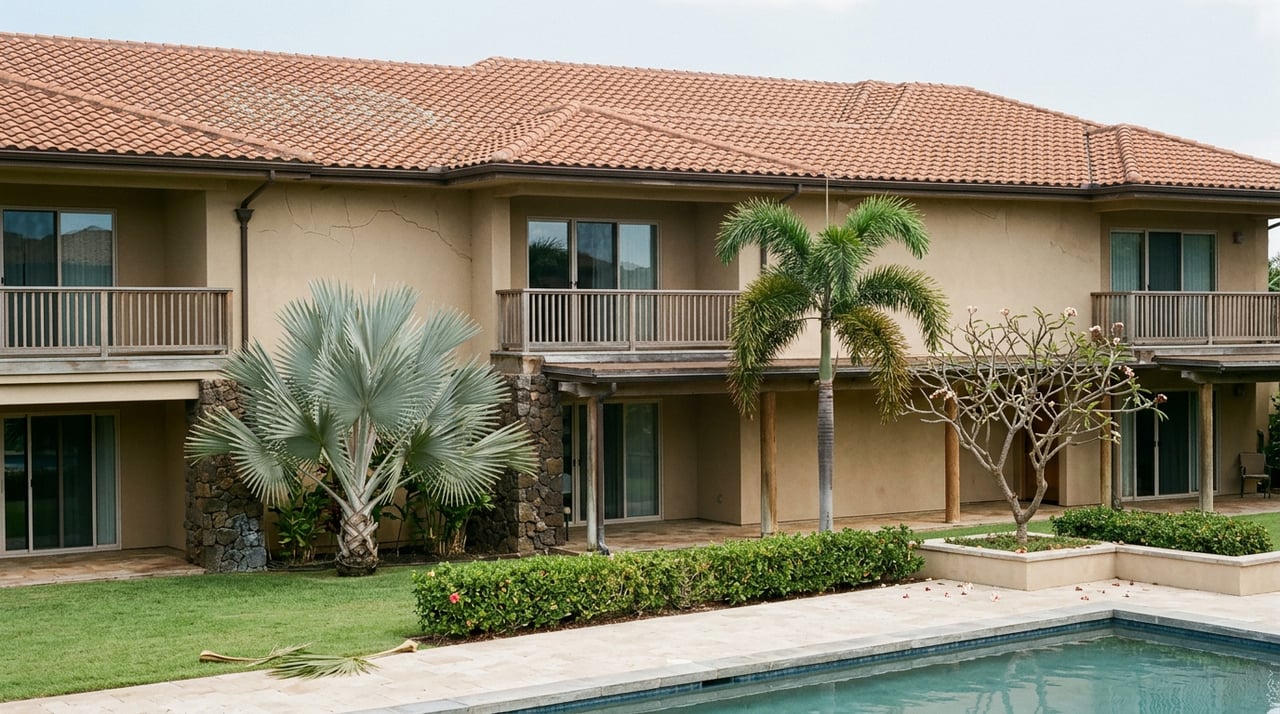
On the night of March 14, 2026, the back three-quarters of the Kihei Kai condominium building dropped about ten feet and folded in on itself. Floodwaters from a Kona low storm had come off South Kihei Road, tunneled under the foundation, and taken the building's footing with it. The resident manager evacuated once the water reached the top of a nearby bridge. A few miles up the same road, in the quieter mauka stretches away from the shoreline, nothing of the sort happened. Buyers there kept closing on homes that same month, largely undisturbed.
That gap between two blocks of the same town is the real story behind a number that should not make sense on its face. In the three months ending June 2026, the median sale price of a home in Kihei was $743,000, down about 9 percent from the same period a year earlier. Over that same stretch, the median price per square foot rose to $879, up about 10 percent. A falling median and a rising per-square-foot price are not supposed to move in opposite directions at the same time. When they do, it usually means the thing being averaged has quietly split into two different products.
The Two Numbers That Don't Match
Kihei homes are also taking longer to sell, averaging around 130 days on market in that same window, up from 114 days a year earlier, with buyers making roughly one offer per listing. Only 74 homes changed hands in June 2026, down slightly from 77 the year before. None of that reads like a market in free fall. It reads like a market where fewer, more selective buyers are paying close attention to which building they're looking at, not just which town.
Kihei still led the island in transaction volume through the first quarter of 2026, with 33 single-family home sales, up 65 percent from the same period a year prior, and 59 condo sales at a median of $610,000, well below the islandwide condo median near $847,000. That volume is real, and it's part of why Kihei remains the entry point for buyers priced out of Wailea. But a median built from that much variety, studio condos next to single-family homes, flood-tested buildings next to buildings that never got wet, tells you almost nothing about what a specific listing is actually worth.
The Zoning Line Nobody Puts in the Listing Photos
Part of the split runs through Maui County's condo zoning code. Bill 9, signed into law on December 15, 2025, phases out short-term rentals in apartment-zoned buildings, the roughly 7,000 units known collectively as the Minatoya List. The timeline is staggered by region: West Maui's deadline lands in 2029, while Kihei and the rest of the county have until January 1, 2031. A companion law, Bill 88, now Ordinance 6008, created new H-3 and H-4 hotel zoning categories so that some of those buildings can keep operating as vacation rentals if they get rezoned in time.
That rezoning process is happening building by building, not island-wide, and it is happening right now. In early July 2026, the Housing and Land Use Committee advanced Resolutions 26-110 and 26-111, which name specific Kihei complexes, including Kamaole Sands, Maui Sunset, and Kauhale Makai, for a path to H-3 or H-4 zoning. Those resolutions are expected before the Maui Planning Commission this month. Being named in a resolution is not the same as being rezoned. It means the process has started, and a buyer looking at any of those buildings today is buying into an outcome that has not been finalized.
Meanwhile, Kihei's already hotel-zoned buildings, Sugar Beach Resort, sections of Kihei Akahi, and Maui Banyan among them, were never part of this fight in the first place. Their short-term rental rights were never in question, and pricing in Minatoya-era apartment-zoned complexes not yet named in a rezoning resolution has fallen as much as 50 percent from 2022-2023 highs in many buildings, according to market tracking cited across Maui real estate coverage this year, while hotel-zoned buildings have held their value far more consistently.
| Zoning status | Kihei examples | Bill 9 exposure | What's happened to price |
|---|---|---|---|
| Already hotel-zoned | Sugar Beach Resort, hotel-zoned units at Kihei Akahi, Maui Banyan | None, rentals were never at risk | Held value more steadily |
| Apartment-zoned, named in Resolution 26-110/26-111 | Kamaole Sands, Maui Sunset, Kauhale Makai | Pending rezoning, outcome not final | Regaining some buyer confidence |
| Apartment-zoned, not yet named | Other Minatoya List buildings in Kihei | Phase-out scheduled by January 1, 2031 | Down sharply in many complexes |
A per-square-foot number pulled from all three rows at once tells a buyer nothing useful.
Why the Water Keeps Finding the Same Streets
The other half of the split is drainage, and it doesn't respect zoning maps at all. Kihei was built on top of what was once wetland, and the storm that hit in March 2026 didn't just fall on Kihei itself. Heavy rain that fell Upcountry cascaded down the slopes of Haleakalā and surged through the same storm drain channels that run along South Kihei Road, according to Honolulu Civil Beat's reporting. Kihei itself saw a little over seven inches of rain, while Kula, north and upcountry of town, saw nearly 50 inches over the same seven days. The road became the funnel for both.
South Kihei Road was closed entirely on March 13 and remained impassable at multiple points three days later. Maui Now reported that a section of pavement in front of Kamaole Beach Park II collapsed into a hole. Kūlanihākoʻi Street turned into what one resident described as a river strong enough to shove cars and a shipping container into each other. The Kihei Youth Center sat with what looked like a moat around it.
Not every building on that corridor fared the same. Kihei Beach Condominiums had spent a little over $20,000 two years earlier on flood barriers. When the water came, those barriers held. "This was a wonderful investment," condo president Steve Gagliardi told Maui Now afterward. "They cost a lot less than repairs." A few properties away, owners weren't as fortunate. Honolulu Civil Beat reported that Gerri Lewis, who has owned a rental property at Kihei Bay Vista since 1999, described the compounding cost of ownership on that stretch bluntly: the insurance and HOA increases, she said, have gotten "outrageous at this point."
That's the second axis of the split. A condo's price per square foot in Kihei increasingly reflects whether it sits on a block that flooded in March, whether its association already spent money on mitigation, and whether its master insurance policy has been repriced since. None of that shows up in a neighborhood-level median.
What to Actually Check Before the Per-Square-Foot Number Means Anything
A buyer comparing Kihei to another South Maui neighborhood on median price alone is comparing an average of buildings that don't behave like each other. Before that number means anything for a specific listing, it's worth confirming a few things directly:
- Whether the building is already hotel-zoned, named in a pending rezoning resolution, or still sitting on the original Bill 9 phase-out timeline, since that status alone has driven price divergence of tens of percentage points between otherwise comparable units.
- Whether the building or the block it sits on took on water during the March 2026 storms, and if so, what the association has done since, sandbags, barriers, elevation work, or nothing.
- What the HOA's master insurance policy looks like today versus its renewal before March 2026, since premiums and deductibles in flood-exposed buildings have moved since then.
- Whether the property sits on the South Kihei Road drainage corridor or on the higher, drier ground away from it, information a flood history search and a conversation with the association can surface faster than any portal filter.
The Median Was Never Going to Answer This
A single Kihei median price is an average of a hotel-zoned unit at Maui Banyan and an apartment-zoned unit still waiting on a rezoning vote, an association that spent $20,000 on flood barriers and one still tallying storm damage. Those are different investments with different risks attached, and the fact that the town's overall median fell while its per-square-foot price climbed is exactly what happens when the safer, more certain half of a split market keeps commanding a premium while the riskier half gets discounted underneath it.
If you're comparing Kihei to Wailea, Makena, or anywhere else in South Maui, the neighborhood-level number is a starting point, not an answer. The building's zoning status, its position relative to the flood corridor, and its association's recent insurance history will tell you more about what you're actually paying for than any median ever will.
If you want a second set of eyes on a specific Kihei building before you make an offer, Laurie Keyhani has spent years working this stretch of South Maui and can help you sort a hotel-zoned unit from one still waiting on a county vote. Let's Connect.
This article is general information, not legal, tax or financial advice. Consult a qualified professional about your situation.