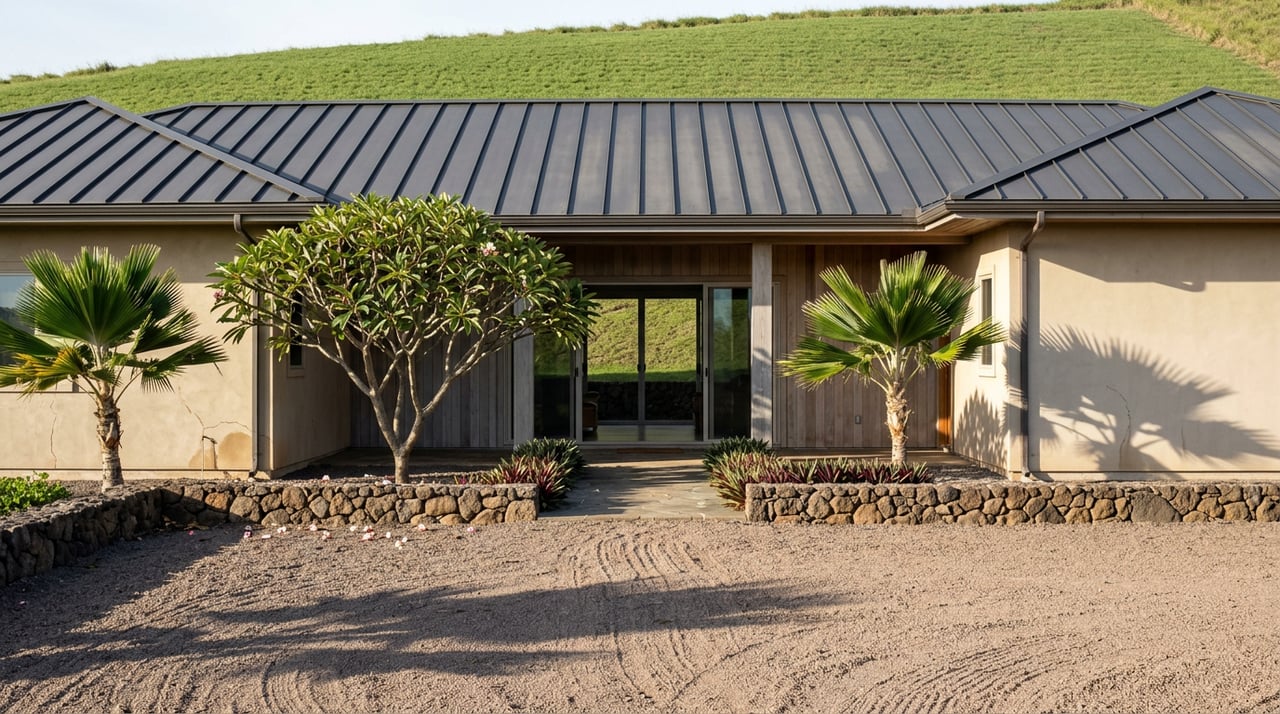
Every listing sheet for a Maui Meadows property with southern exposure describes the same thing: open land, sweeping views, quiet privacy above the resort corridor. For most of the last thirty years, that description has matched the present view, while plans for the land have continued to change. The land isn't undeveloped because nobody has plans for it. It's undeveloped because the plans keep getting sent back.
On August 6, 2026, that cycle turned again. A three-judge panel on the Hawai'i Intermediate Court of Appeals ruled that the Maui Planning Commission used the wrong legal standard when it approved the second phase of the Honua'ula project in 2022, and ordered the commission to reconsider whether the development needs an entirely new environmental review. The ruling landed several weeks before this piece was written, which makes it the freshest fact in a very old story, and it changes what a Maui Meadows buyer is actually looking at when they stand on a lanai and look south.
What Actually Got Settled Last Year
To understand what the court just reopened, it helps to know what had, until recently, looked closed.
Honua'ula, known for most of its history as Wailea 670, is a 670-acre master-planned community proposed for the southeast flank of Haleakalā, directly bordering Maui Meadows on its southern edge. The Maui County Council first approved conditional zoning for the project in 2008 under Ordinance 3553, capping it at 1,400 units split evenly between market-rate and workforce homes, with an 18-hole golf course built in.
That version never got built. In September 2024, Honua'ula Partners LLC formally applied to amend the governing ordinances, asking to drop the golf course entirely and rework the workforce housing terms. The county council spent the better part of a year on it, and on a narrow 5-4 vote in July 2025 passed a bill on first reading that cut the total unit count from 1,400 to 1,150 and reduced the workforce housing requirement from 700 units to 288. A second and final vote followed by the same 5-4 margin.
Mayor Richard Bissen signed both bills into law on August 20, 2025. Bill 171 became Ordinance 5846, formally removing the golf course requirement and capping market-rate construction at no more than 100 units per year. Bill 172 became Ordinance 5847, locking in the 288-unit workforce housing floor and requiring Honua'ula Partners to widen Pi'ilani Highway from two lanes to four between Kilohana Drive and Wailea Ike Drive. In his signing statement, Bissen said the project had been "passionately debated in our community for nearly 30 years," adding that he signed off to provide critically needed housing even though the outcome, by his own account, wasn't ideal.
That was the version of the story most people heard: after decades of stalling, Honua'ula finally had its zoning locked in. Bissen signed. The council voted. The path was clear.
What the Court Just Reopened
It wasn't the whole path. It was one piece of it.
The August 2025 ordinances settled the zoning conditions: unit counts, the workforce housing floor, the highway widening obligation, the golf course removal. What they didn't settle was whether the project's 2012 environmental impact statement still covered a development this different from the one it originally described.
The appeals court found that when the Planning Commission approved Honua'ula's Phase II in 2022, it asked the wrong question. Instead of determining whether the project had substantively changed in size, scope, intensity, use, location, or timing since 2012, and only then deciding if a supplemental review was legally required, the commission simply concluded that county law didn't explicitly mandate one. The court vacated that portion of the commission's decision and sent it back for a proper review.
Maile Lu'uwai, president of Hoʻoponopono O Mākena, one of the groups that brought the challenge, said the court's decision affirms that "significant changes to a development cannot bypass meaningful environmental review." Attorney Lance Collins, who represented the community groups alongside Bianca Isaki and Ryan Hurley, said they're now evaluating whether to seek further review from the Hawai'i Supreme Court. On the other side, Honua'ula's attorney Cal Chipchase pointed to the project's committed community benefits, including the 288 workforce units, a cultural center, and a planned joint police and fire station.
The court didn't reopen everything. It specifically found that the earlier fights over housing unit counts and the golf course requirement were moot, because the 2025 ordinance changes had already resolved them. So the zoning is not back in play. The environmental question is.
Here's the practical difference for a buyer trying to size up the neighborhood:
| Locked in by ordinance (August 2025) | Reopened by the court (August 2026) |
|---|---|
| Golf course requirement removed entirely | Whether Phase II needs a new EIS |
| 288-unit workforce housing floor | Timeline for construction to begin |
| Pi'ilani Highway widening, Kilohana to Wailea Ike | Whether the case goes to the Hawai'i Supreme Court |
| Market-rate cap of 100 units per year | Any further design changes tied to a new review |
Why This Land Moves So Slowly
Part of why Honua'ula has taken thirty years isn't political inertia. It's what's actually on the ground.
The 670-acre site spans four traditional ahupua'a, Paeahu, Palauea, Keauhou, and Honua'ula, where archaeological surveys have documented dryland agricultural terraces, stepping-stone trails, and burial sites. A 2016 settlement between the developer, Sierra Club of Hawai'i, and Maui Unite set aside more than 160 acres for native forest and archaeological protection, and required a deer fence to protect endangered plants from grazing. Within that preserved acreage sits a 130 to 134-acre Native Plant Preservation Area, home to a remnant wiliwili dryland forest that shelters the endangered 'āwikiwiki vine, Blackburn's sphinx moth, and the nēnē, Hawai'i's state bird.
None of that is a footnote to the zoning story. It's the reason the zoning story keeps stretching. Every time the project's footprint shifts, even slightly, the question of whether the conservation commitments and cultural protections still hold has to be asked again. That's exactly the question the appeals court just told the Planning Commission it skipped.
What a Maui Meadows Buyer Should Actually Watch
Maui Meadows has had a seat at this table longer than most of its current residents realize. The Maui Meadows Neighborhood Association lists providing input on Honua'ula as one of its standing priorities, alongside protecting the neighborhood's rural zoning, limiting short-term rentals, and maintaining firebreaks. This isn't a new fight the neighborhood is walking into. It's one the association has been tracking through every version of the project's name and shape.
For someone evaluating a half-acre lot on Maui Meadows' southern streets, that history points to two separate facts that are easy to blur together.
The first is that certain protections for the neighborhood are already part of the project's approved zoning conditions and don't depend on how the environmental review turns out. The court's ruling was narrow. It vacated the environmental review portion of the Planning Commission's decision and left the rest, including the boundary and design conditions tied to Maui Meadows, untouched.
The second is that the timeline for anything actually breaking ground south of the neighborhood is now less certain than it was a year ago, not more. A supplemental EIS, if the Planning Commission determines one is required, means new hearings, new public comment periods, and potentially another appeal. More than a year after the mayor signed the zoning ordinances, no construction has started on the site.
If you're touring a Maui Meadows property this year and the listing mentions unobstructed southern views, it's worth asking two things directly: how close is the parcel to the Honua'ula boundary, and has the seller or agent tracked the project's status since the mayor signed the 2025 ordinances. That question matters because the story had appeared to end in August of last year. It didn't.
The Land Isn't Waiting to Be Developed or Protected. It's Paused.
The easiest mistake to make about the land south of Maui Meadows is treating it as one of two things: a project that's finally moving forward, or open space that will stay open. It's neither right now. It's a legally contested parcel where some conditions are permanent and others are back under review, with the people who live next to it having weighed in on every version of the plan since the 1990s.
That distinction matters more than a median price or a square footage number when you're deciding whether the quiet hillside above Wailea is going to stay quiet, and for how long.
If you're weighing a purchase in Maui Meadows and want a straight read on what's actually settled versus what's still moving, that's exactly the kind of question Laurie Keyhani spends her time answering for clients before they make an offer, not after. Let's Connect.
This article is general information, not legal, tax or financial advice. Consult a qualified professional about your situation.