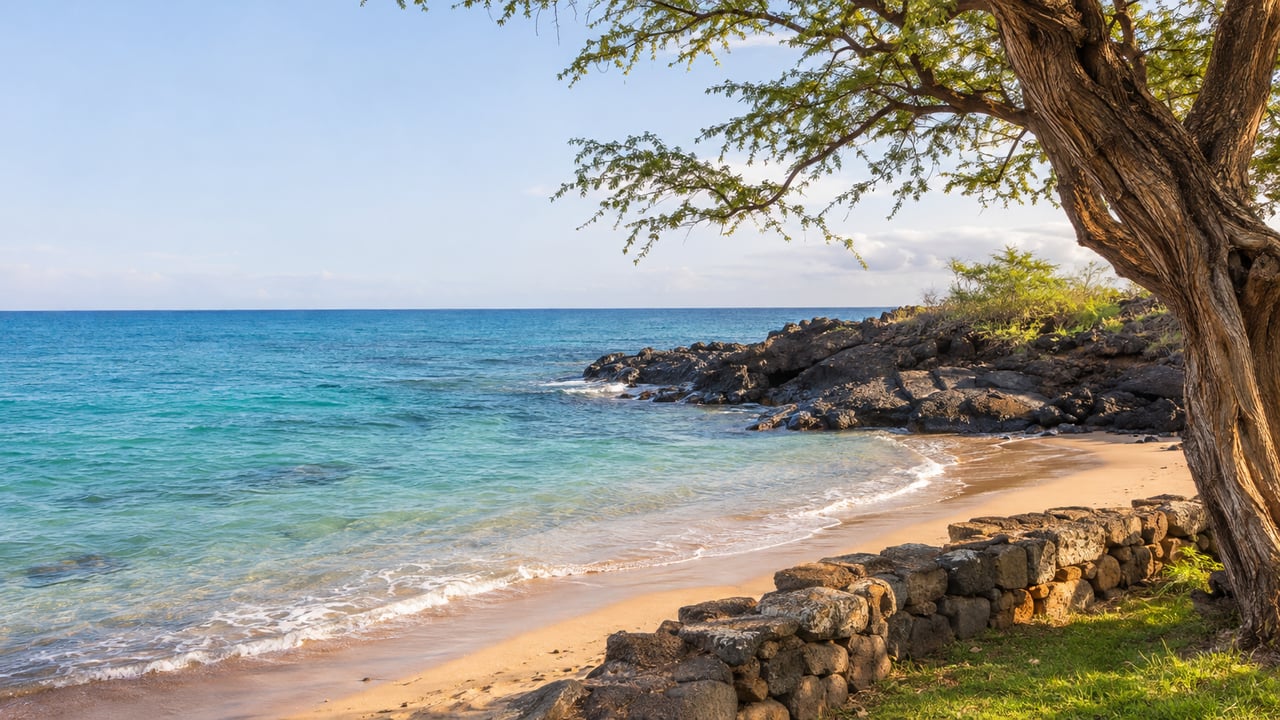
Buck Joiner was planting naupaka on a cleared lot between Kamaʻole II and Kamaʻole III when he found a hole in the ground about as long as his arm. He couldn't tell what had dug it. According to The Maui News, he told state biologist Fern Duvall, who was overjoyed and identified it as the burrow of a wedge-tailed shearwater, the ʻuaʻu kani.
That lot is now Kamaʻole Point Park, and it was the first place in South Maui where ʻuaʻu kani reestablished themselves. The park turned 25 this month. The anniversary falls at an awkward time for the birds, because their chicks leave the burrows over the next two months. The volunteers who built the park removed most of what used to threaten the colony. The hazard state wildlife officials name for this season is artificial light, and it comes from the homes, condos and streetlights along South Kīhei Road.
A Mall Site, Then a Dumping Ground, Then Dunes
The Maui News reported that the park started as a proposal for a two-story shopping mall. A 10-year community campaign of public testimony, letters and petitions followed, aimed at keeping the coastal parcel out of commercial use. In his own account for the Kīhei Community Association, Joiner said developers bought the two-acre parcel in October 1988 and the shopping center was proposed in 1989. He also said he promised that if the County bought the land, he would turn it into a park.
The County bought it in 1998. The Maui News puts the price at $6.35 million, and Joiner's Kīhei Community Association account gives $7.2 million. The property was in rough shape. The Maui News describes barbed-wire fencing around burned-out cars, a collapsed house, fallen kiawe trees, abandoned beds and couches, and household trash.
The day after the purchase, Joiner and more than a dozen volunteers started clearing the land. They filled 65 contractor bags with trash on the first day. Volunteers then worked every Sunday for three years, which Joiner counted as "170 Sundays." They laid irrigation pipe, rebuilt the sand dunes with truckloads of sand dredged from the Kīhei boat ramp, and planted naupaka to hold the dunes in place. Local businesses lent trucks and heavy equipment to haul away the biggest debris. Joiner handed the finished park to the County on Oct. 7, 2001.
Restoring the dunes and clearing out invasive plants made a beach park. It also made the loose, planted sand that shearwaters dig into. Joiner found that first burrow while planting the naupaka that was holding the new dunes together.
What Filled the Burrows Was Fewer Predators
Habitat brought the birds back, and removing predators let the colony grow. The Maui Nui Seabird Recovery Project supports the colony. It told The Maui News that the colony now stretches along about a third of a mile of coastline from the park to the Keawakapu boat ramp. After mongoose and free-ranging cats were removed from the area, the number of burrows rose from 376 in 2017 to 1,394 in 2025, nearly a fourfold increase in eight years.
Each pair lays a single egg a year, and the parents take turns guarding the nest and fishing. So the burrow count is close to a count of the chicks the colony can produce each year. That is also why losing chicks during fledging season costs a colony like this so much.
The birds don't always stay inside the wooden fence that marks their area. Joiner told The Maui News:
"We haven't been able to come up with a sign that tells them, 'This is your part and this is our part.'"
The park could use some attention of its own. Michael Moran, a Kīhei Community Association board member and past president, told the paper the park "could use some tender loving care" and that organizers hope the County will invest in it. Joiner hopes the County or a nonprofit will make it an educational site where visitors can see native plants. Organizers planned a small native planting project for the Oct. 17 celebration. The Kīhei Community Association, Sierra Club Maui Group and Maui Tomorrow Foundation co-sponsored it.
The Colony's Calendar Has Reached Its Riskiest Stretch
The Maui Nui Seabird Recovery Project's ʻuaʻu kani life cycle runs roughly like this:
| Period | What's happening in the burrows |
|---|---|
| Mid-March to late April | Adults return to the colony |
| May | Adults leave for a pre-laying exodus |
| June | Eggs are laid |
| June to July | Incubation |
| Early August | Chicks hatch |
| November to December | Chicks fledge |
At this point in the season, with hatching in early August and fledging not due until November, the burrows behind the fence hold chicks that haven't flown yet. The Hawaiʻi Department of Land and Natural Resources defines seabird fallout season as roughly Sept. 15 through Dec. 15. During those weeks, artificial lighting can throw young birds off course on their first flights. Disoriented birds may hit structures or come down on the ground, where predators and traffic can reach them. Most of the November-to-December fledging window that the Maui Nui Seabird Recovery Project gives falls inside that period.
The moon matters too. Maui Now reported in November 2025 that fallout risk goes up when fledging coincides with the dark skies of a new moon. With no moonlight, the lights along the coast are the brightest thing a young bird can see.
Across the Road, Your Porch Light Is Part of the Habitat
Kamaʻole Point sits right on South Kīhei Road. The parking for the anniversary event was across the street at the corner of Keonekai Road. The chicks fledge from burrows within sight of the porch lights and streetlights on the other side of the road.
DLNR's guidance for the season covers things anyone near the coast can do:
- Turn off outdoor lights you don't need.
- Point fixtures downward and shield them.
- Use low-intensity, warm-colored bulbs.
- Draw curtains so indoor light doesn't spill outside.
- Keep pets indoors or on a leash.
The pet advice ties back to the colony's history. Removing free-ranging cats and mongoose is what took the burrow count from 376 to 1,394. A loose dog on the grass at Kamaʻole Point brings back the same kind of pressure, and burrows that have spread past the fence are easy to reach.
If a Bird Comes Down Near You
A grounded shearwater doesn't always need help. DLNR asks people to check first, because a chick near its burrow may be fine where it is. If the bird is injured, unresponsive or somewhere unsafe, such as a parking lot or the road shoulder, DLNR's steps are:
- Place it gently in a ventilated box.
- Keep the box somewhere quiet and dark.
- Don't give it food or water.
- Call the Maui contact as soon as you can.
On Maui, DLNR's Division of Forestry and Wildlife lists 808-573-BIRD (2473) and 808-359-0403. The Maui Nui Seabird Recovery Project's found-a-bird page gives the same 573-BIRD line. Putting it in your phone before the November new moon means you won't need to look it up while holding a box.
If you'd like to do more, the Maui Nui Seabird Recovery Project runs a Kīhei colony-guardian program and volunteer habitat restoration days, and it monitors how many chicks the colonies raise each season. Volunteering there continues the Sunday work that built the park.
I grew up watching South Maui change, and the work done at Kamaʻole Point still means a lot to me. If you're trying to get to know the stretch of coast between the Kamaʻole beaches and Keawakapu, from its parks to the streets on either side, I'm glad to talk it through. Laurie Keyhani is here when you're ready. Let's Connect.