Look at a South Maui search on any portal and Wailea sits at the top of the price stack, with Maui Meadows a step below on paper. That gap looks like a discount for being uphill from the resorts. It isn't. The gap is what buyers pay to trade a covenant-controlled resort community for a residential subdivision where the county code, not an HOA, decides what you can build. In 2026's split market, that difference is doing more work than the median suggests.
The number that doesn't fit
Two market readings sit uneasily next to each other right now. Maui's condo segment is in a real correction: median condo sales price for the first half of 2026 declined 12.1% to $650,000, and average condo sales price declined 19.9% to $1,001,721. By June, condo inventory reached 14.2 months of supply while single-family home inventory reached 8.1 months. Meanwhile, on the single-family side, Q1 2026 volume remained thin with 9 sales year-to-date at a median of $2,737,500, but prices remain firmly in premium territory.
Read those together and a pattern emerges. The condo softness is concentrated where regulatory uncertainty lives. Bill 9 remains the defining regulatory force in the condo segment, and the Maui Planning Commission's February 2026 denial of the proposed H-3/H-4 hotel zoning framework means the process is now with the County Council, which requires a supermajority of six votes to proceed. Single-family in South Maui, and Maui Meadows in particular, is insulated from that specific fight. Its value proposition was never nightly rental income. It was land, cottage rights, and no committee to answer to.
That is the thesis worth carrying into a tour: in Maui Meadows, you are not buying a smaller Wailea. You are buying a different legal instrument.
What the zoning actually lets you do
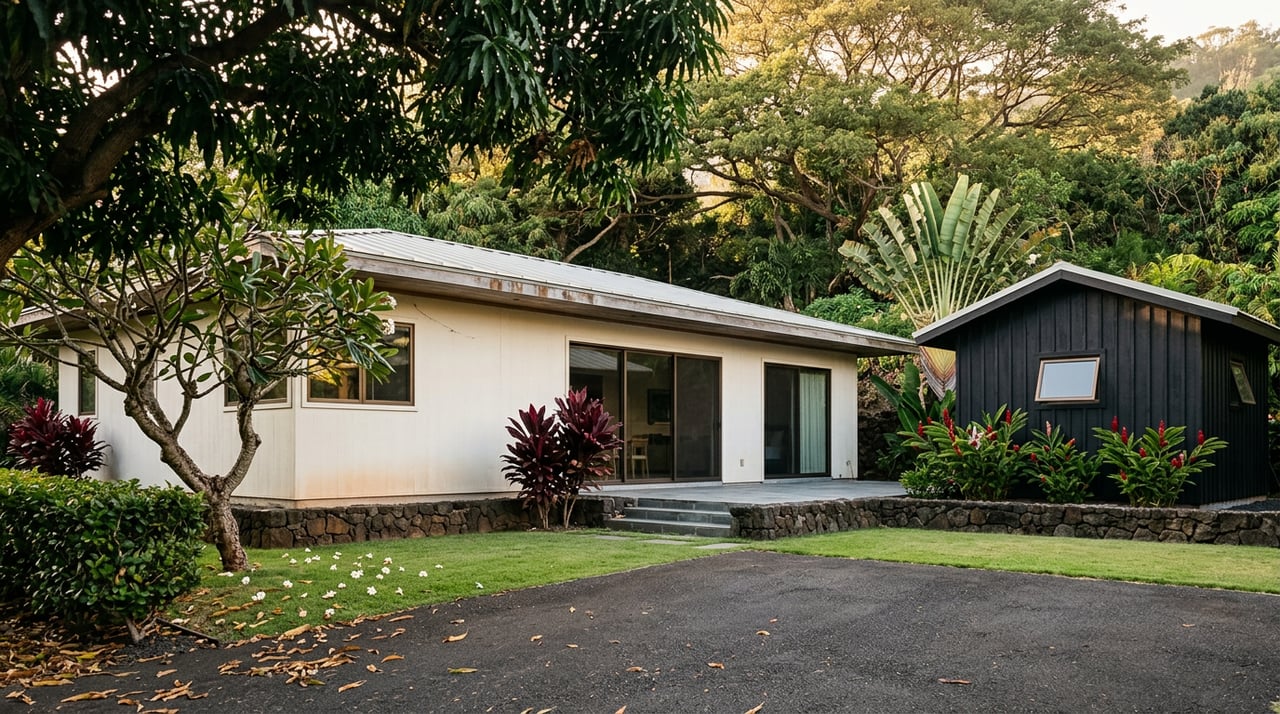
Maui Meadows sits on the hillside directly above Wailea, at the Kihei-Wailea border. It's a residential neighborhood of about 500 homes on the side of Haleakala, technically in Kihei, with minimum half-acre lots and zoning that allows an additional cottage to be built, though no nightly rentals are permitted. Unlike some other Wailea-area neighborhoods, Maui Meadows is not a gated community and doesn't have an HOA or community association to enforce neighborhood policies.
The accessory dwelling piece is where the buyer's math actually shifts. Maui County ties the maximum cottage size to lot area:
| Lot area (sq ft) | Max accessory dwelling |
|---|---|
| Up to 7,499 | 500 sq ft |
| 7,500 to 9,999 | 600 sq ft |
| 10,000 to 21,779 | 720 sq ft |
| 21,780 to 43,559 | 840 sq ft |
| 43,560 to 87,119 | 960 sq ft |
Those tiers come straight from the county's development standards for accessory dwellings, which the Maui County Code labels "accessory dwellings" rather than "ohanas," with maximum square footage keyed to the net area of the lot. A half-acre Maui Meadows parcel sits in the 21,780 to 43,559 sq ft tier, which lands the cottage cap at 840 sq ft. A one-acre parcel pushes it to 960 sq ft. Compare that to a standard Kihei residential lot near 7,500 sq ft, where you cap out around 600.
The practical effect: an owner in Maui Meadows can legally build or inherit a permitted cottage that functions as a long-term rental, a multigenerational suite, or a caretaker's quarters, on the same title as the main house. In Wailea proper, that path is largely closed. As Maui broker Tom Tezak has explained, Wailea does not allow homes with ohanas outside of a handful of caretaker spaces, while Maui Meadows has many because those properties are half-acre lots that can support a cottage over 700 square feet.
The price gap isn't paying for altitude. It's paying for optionality the covenants downhill won't grant.
Reading the 2026 market through that lens
Now put the numbers back on top of the zoning. It is still a buyer's market at 7.6 months of absorption, but the direction appears to be shifting, and the shift is uneven by property type. Condos priced against a nightly-rental future are being repriced against a slower one. Single-family homes with permitted cottages, generational fruit trees, and no HOA are being priced against something more durable: what it would cost to reproduce that lot and that entitlement today.
That's why entry-level Maui Meadows homes have held their ground while entry-level condos three miles down the hill haven't. As of April 2026, the Maui home median was down 7% to $1,300,000 and the condo median down 13% to $645,000, with condo days on market at 128 versus 107 for homes. Rate context matters here too. The 30-year fixed averaged 6.46% as of April 2, 2026, its highest in seven months, following a brief dip below 6% in late February, and Maui's buyer pool skews significantly toward cash buyers and buyers with substantial equity. The Maui Meadows buyer, more often than not, is not shopping a rate sheet. They're shopping a lot.
Pricing inside the subdivision reflects that. Typical pricing runs $1.4 to $2M, with larger, newer homes moving to $3M, while the gated enclave of Kai Malu Estates, tucked in its own section of Maui Meadows, showcases rarely listed homes on 2-acre parcels in the $5M to $7M range. The neighborhood also drew luxury-buyer attention early in the year, with homes in Spreckelsville, Kaanapali, and Maui Meadows going under contract at the $3M-plus tier in January 2026.
The tradeoffs a Wailea shopper needs to price in
The optionality cuts both ways. A neighborhood without a design review board looks different from one with a design review board. Originally developed in the early 1970s, Maui Meadows is an eclectic mix of styles and architecture, with no sidewalks and very little night lighting, creating a secluded tone that many residents find magical. If a buyer is coming from a resort community and expecting curb uniformity, that visual is a surprise, not a feature.
Three specific frictions worth pricing in before you write an offer:
- Housing stock age. Much of the inventory dates to the 1970s and 1980s. Inspection scope should include roof, cesspool-to-septic status, electrical panels, and any owner-built additions. Ask whether the existing cottage was permitted or grandfathered, and whether the county's records match what's on the ground.
- Water meters and utilities. Older lots sometimes carry undersized meters. Buyers planning to add or expand a cottage should verify meter size and capacity early, because upsizing is a separate county process, not a closing item.
- Slope and drainage. The neighborhood climbs the hillside from two entrances off Piilani Highway. Both meander to the top of the ag-zoned subdivision, and those at the very top share a fence with the adjoining 20,000-acre Ulupalakua Ranch. View premiums are real at the top of the hill, but so are grading, retaining-wall, and runoff considerations on custom builds.
Then there is what you give up going uphill. No walk to Wailea Beach Path. No resort concierge. No gate at the entrance. The Kamaole beaches and Keawakapu are a short drive rather than a stroll. For a buyer whose lifestyle picture is "walk to the sand with a coffee," Maui Meadows isn't the answer. For a buyer whose picture is "orchard, pool, cottage for parents, and a lanai that sees Molokini," it often is.
Frequently asked questions
Can I short-term rent the cottage in Maui Meadows? No. Some cottages are long-term rentals and some are caretakers' homes, but no nightly rentals are allowed in the subdivision. Underwriting income assumptions against a monthly lease, not a vacation-rental pro forma, is the honest exercise.
Is Maui Meadows part of any HOA? Maui Meadows does not have an active HOA. That means no monthly dues on the main subdivision and no architectural review board, but it also means neighbor-to-neighbor issues resolve through the county, not a board.
What lot size should I look for if I want the biggest permitted cottage? The county code steps the cottage cap up at 21,780 sq ft (roughly half an acre) and again at 43,560 sq ft (one acre). A half-acre lot supports up to 840 sq ft. A full acre supports up to 960 sq ft. Confirm the buildable footprint separately, because setbacks, slope, and existing structures narrow what the raw lot area implies.
How does Bill 9 affect Maui Meadows? The Bill 9 fight is a condo-and-apartment-zoning fight. Maui Meadows single-family homes and permitted cottages sit outside that regulatory question, which is one reason SFH pricing in the neighborhood has behaved differently than the Wailea condo segment through 2026.
If you're weighing a Wailea condo against an uphill single-family home this year, the right comparison isn't square foot to square foot. It's what each title actually lets you do for the next twenty years. That's the conversation Laurie Keyhani has with South Maui buyers every week. Let's Connect when you're ready to line the two options up honestly.