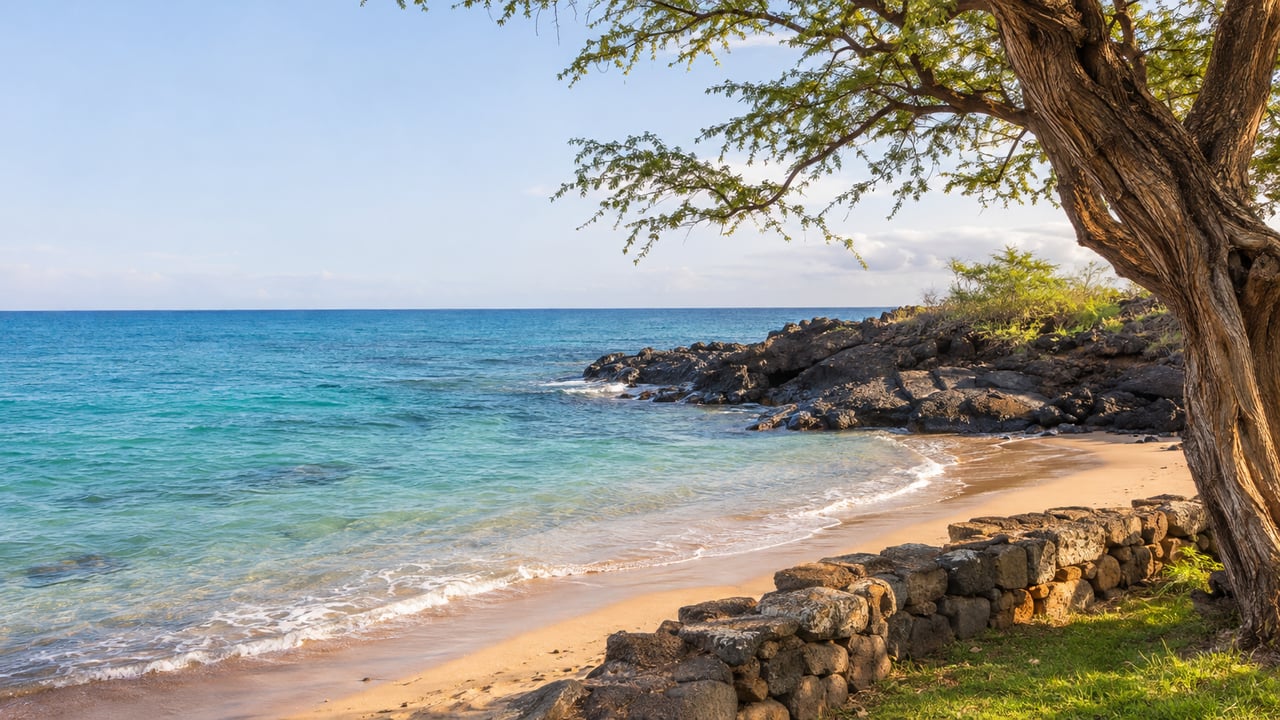
"Nesting can occur right at sunset and hatchlings may come out anytime day or night." Hannah Bernard, executive director of Hawaii Wildlife Fund, said in July, according to Maui News. She wasn't talking about turtle biology in general. She was talking about light switches at Oneloa.
Big Beach has stayed dark at night for a simple reason: there has been nothing there to light. Five porta-potties stand at the beach entrance, and there are no showers. Residents told Maui Now they bring their own jugs of water or drive to other beach parks to rinse off. That is about to change. In July 2026 the Maui Planning Commission voted 6-1 to approve a Special Management Area permit for two restroom and shower buildings at Mākena State Park. The plan that passed differs from the one first proposed, though. Between June and July it was rebuilt around one of the rarest animals using the beach, and the darkness that used to come from having no buildings now comes from conditions on the permit.
The beach a turtle ranks highly
Bernard told the commission in June that studies rate Oneloa among the most important beaches on Maui for nesting hawksbill turtles, or honu ʻea, which are on the endangered species list. She pointed to three reasons: the quality of the sand, the water, and the natural darkness at night. By the fund's count, hawksbills made four nests in the park in 2025, and Bernard called the season "highly successful."
Two of those three conditions are geology and ocean. Only the darkness depended on what people decided to build. At a hearing later that month, Bernard described turtles nesting at Oneloa and hatchlings heading toward lights. The commission deferred action that day, and the state went back to revise the plan.
How the plan changed between June and July
The project the State Parks Division brought in June was fairly simple. It included two comfort stations of about 1,300 square feet each, built beside the north and south parking lots. Each would have four women's toilets, three men's toilets, a urinal, and sinks. Plans also called for two outdoor showers next to the buildings and new water lines feeding the toilets, sinks, and a water-filling station. The state's consultant described the existing porta-potties as reaching over 100 degrees inside.
Here is what happened next:
- July 2. The State Parks Division sent a letter outlining a revised plan. It says the division consulted with the U.S. Fish and Wildlife Service and cut the exterior lights at each comfort station from six to one.
- The fixture itself. That one light is shielded, points down, sits recessed under the roofline, and is mounted on the side of the building facing away from the shoreline.
- The timer. All lights inside and outside run on timers and go off at 8 p.m. That gives staff about an hour to clean after the park closes.
- Room to go darker. The division wrote that the remaining lighting could be reduced further or removed entirely if operations don't need it.
- July 14. Division administrator Alan Carpenter submitted the revised proposal. It also moved more of the parking onto pervious surfaces to cut rain runoff, with a limited number of paved stalls to meet the Americans with Disabilities Act.
- The vote. The permit passed 6-1. The commission also ordered the state to deliver a carrying-capacity study by July 31, 2028, looking at the ecological, environmental, and physical effects of activity in the park.
According to the division, Fish and Wildlife expects that with these measures the project's effects on Hawaiian sea turtles, seabirds, waterbirds, and other federally listed species will be insignificant. Bernard said she would have preferred no lighting at all, but she was encouraged by the consultation and said the fund will keep monitoring the project. Albert Perez, executive director of Maui Tomorrow, called the pervious parking "a victory."
Not everyone was persuaded. Commissioner Mark Deakos cast the only no vote. "This is the last beach that still has dark skies," he said. Perez still opposes the buildings because of the extra load more visitors could put on lifeguards, and former Mākena lifeguard Jasen Kaimikaua spoke against the expansion for the same reason. Both sides were arguing about the same thing: how much a wilderness beach can absorb.
The park now runs on two schedules
Put the park's posted hours next to the new lighting rules and you can see how the permit fits the people schedule around the turtle schedule.
| Time | What happens at Mākena State Park |
|---|---|
| 5:00 a.m. | Oneloa, Oneuli, and Puʻu Olaʻi open |
| 4:00 p.m., Sat & Sun | Puʻu Olaʻi (Little Beach) closes on weekends |
| 7:00 p.m. | Oneloa and Oneuli close; Puʻu Olaʻi closes on weekdays |
| 8:00 p.m., once built | Comfort station lights, inside and out, shut off on timers |
| Overnight | No building light on the beach side; nesting and hatching can happen any time |
The later 7:45 p.m. closing for Oneloa and Oneuli only applies in May, June, and July, so the 7 p.m. close is the one in effect now. The hour between closing and lights-out is there for cleaning crews. Once that hour ends, the beach is back to the dark conditions Bernard credited for the 2025 nests.
October still falls inside the turtles' calendar. The state's Division of Aquatic Resources says hawksbill nesting in Hawaiʻi usually runs from May to December, and hatchlings emerge about two months after eggs are laid. Green sea turtles nest from late April through late October, and their hatchlings generally appear from August through November. Hawaii Wildlife Fund's 2026 calendar lists Maui sea turtle nesting activities through November 30.
What stays the same at Big Beach
At the June 23 hearing, the state's consultant, Gwendolyn Rivera of Munekiyo Hiraga, took on rumors that the bathrooms would bring tighter control of the park and answered them one by one. The project includes no park fencing or gates, apart from small fenced enclosures around the wastewater tanks. It adds no reservation or shuttle system and no single access point. It doesn't ban walk-ins, doesn't change parking or access rules or street parking outside the park, and does no work in the shoreline area.
Fees haven't changed either. Hawaiʻi residents get in and park free with a state driver's license or ID. Nonresidents pay $5 per person plus $10 per vehicle, and children 3 and under are free. Parking can be paid at the kiosks or online through the state's ParkMobile link. Today the park still has no drinking water, and the posted warning about dangerous shorebreak still applies.
As for timing, the June coverage put the project at about a year to build and just over $2 million, with the state planning to start once the permit was approved. No start date has been announced since the July vote, so for now the porta-potties are still in place. The park did close briefly for Nolo. State parks on Maui shut down on September 25 as a storm precaution, and by the state's September 28 update they had reopened, with Mākena not among the exceptions.
Sharing Oneloa through the end of the season
The permit handles the buildings. Darkness on the sand during the rest of the year depends on beachgoers. State and conservation guidance comes down to a few habits:
- Stay at least 10 feet from turtles, nests, and hatchlings, and leave marked nest barriers alone.
- Never pick up a hatchling or carry it to the water.
- Turn off or shield any light that shines on the beach. If you're on the sand after dark, use a red-filtered light, and skip beach fires and driving on the sand.
- Report nesting activity, hatchlings, or injured turtles to NOAA's 24-hour Marine Wildlife Hotline at 1-888-256-9840. The state asks that every hawksbill sighting be reported there, with photos sent to HIhawksbills.org.
If you'd rather help directly, Hawaii Wildlife Fund's Hawksbill Recovery Project takes volunteers for three shifts. Dawn Patrol searches for tracks and nests, Night Patrol observes nesting females, and Nest Watch covers both day and night. You can sign up through the fund's volunteer page or email [email protected]. Since the 2026 calendar doesn't list a location, check with the fund about which beach you'd be assigned to. On October 31, Pacific Whale Foundation is holding a Halloween cleanup at Māʻalaea Harbor through HandsOn Maui. The foundation's Coastal Marine Debris Monitoring Program also lets volunteers adopt the Maui beach of their choice and log what they collect.
The state estimates that about 500,000 people use Mākena State Park each year, close to 120,000 of them visitors. In 2025, the same stretch of sand held four hawksbill nests.
Big Beach is part of what makes Makena home for a lot of us. If you own near the park and want to understand how projects like this could shape your mornings and evenings on the sand, I'm happy to talk it through over coffee in Kihei. Laurie Keyhani | Let's Connect.
This article is general information, not legal, tax or financial advice. Consult a qualified professional about your situation.